Africa’s Data Moment
Published: January 2026
Why Digital Growth Without Assurance Is a Continental Risk
Africa is digitizing faster than it is governing data.
That imbalance is no longer a future concern—it is a present, systemic risk.
Across the continent, governments, banks, telecoms, and enterprises are accelerating digital transformation at unprecedented speed. Cloud platforms are scaling rapidly. Analytics, artificial intelligence, and automation are becoming strategic imperatives rather than optional capabilities. Investment in digital infrastructure is compounding year over year.
Yet beneath this visible progress lies a structural fault line.
Africa is building data scale without data assurance.
This is not a tooling gap.
It is not a talent shortage alone.
It is an
assurance maturity failure.
The Assurance Gap:
Where Digital Progress Becomes Fragile
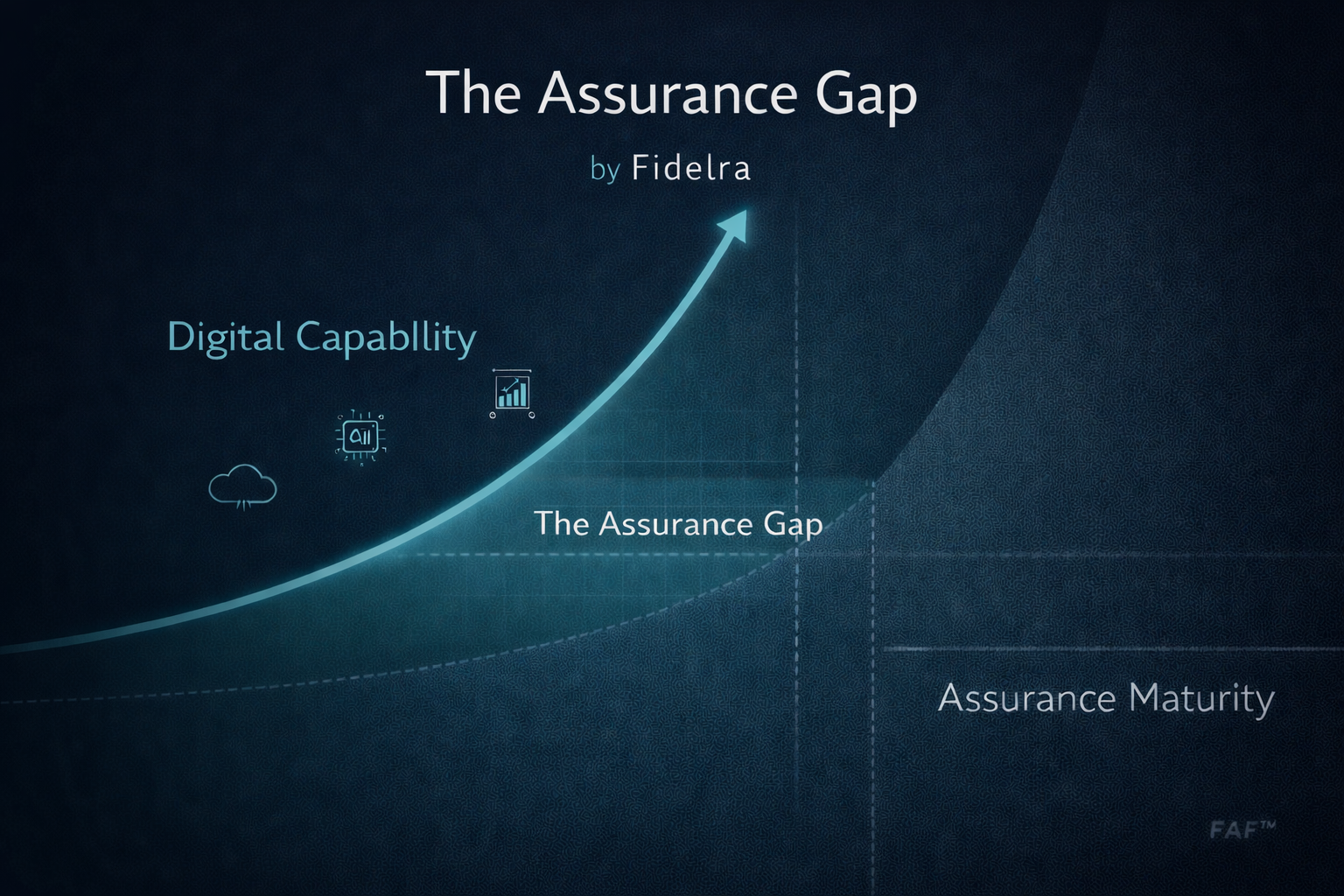
Africa’s data economy is growing in complexity faster than its governance maturity. A dangerous divergence is emerging:
- Capability compounds — AI, cloud, analytics, and automation accelerate
- Control stagnates — governance, evidence, and assurance lag behind
This divergence creates the illusion of success. Platforms appear modern. Dashboards look impressive. KPIs trend upward. Institutions interpret momentum as maturity.
But modernization built on discretionary change—change that is not formally governed, measured, or continuously validated—remains structurally fragile.
Fidelra defines this divergence as the Assurance Gap.
The Assurance Gap is the distance between what an institution operates and what it can defend under regulatory, audit, or forensic scrutiny.
The gap persists because it does not disrupt day-to-day operations. Systems continue to run. Products continue to ship. Decisions appear justified. The weakness is invisible—until scrutiny is applied.
When the Gap Is Exposed
Within the Assurance Gap, organizations experience the illusion of progress—until a trigger event occurs:
- A regulatory inquiry
- A data breach or prolonged outage
- A cross-border audit or investigation
- A public trust or reputational failure
At that moment, modernization built on intent rather than proof is exposed. Evidence cannot be produced quickly. Decisions are justified retrospectively. Controls exist on paper but not as living systems.
What appeared to be digital maturity is revealed as unmanaged risk.
The Regulatory Shift:
From Intention to Proof
Africa’s regulatory landscape has moved decisively beyond the grace period.
From Kenya’s Office of the Data Protection Commissioner (ODPC), to Nigeria’s Data Protection Commission (NDPC), to South Africa’s Information Regulator, expectations are converging around a single principle:
Regulators no longer ask what you intend to do.
They ask what you can prove.
This shift reflects a global regulatory reality: compliance is no longer a narrative exercise. Policies, frameworks, and declarations are insufficient unless they are supported by continuous, verifiable evidence.
Yet most institutions still rely on episodic assurance:
- Evidence assembled only when requested
- Controls described, not continuously validated
- Decisions justified after the fact
In the modern digital economy, compliance without continuous evidence is a story—not a control.
Introducing the Fidelra Assurance Maturity Model™ (FAMM™)
To move the conversation from opinion to institution, Fidelra introduces a proprietary evaluative lens:
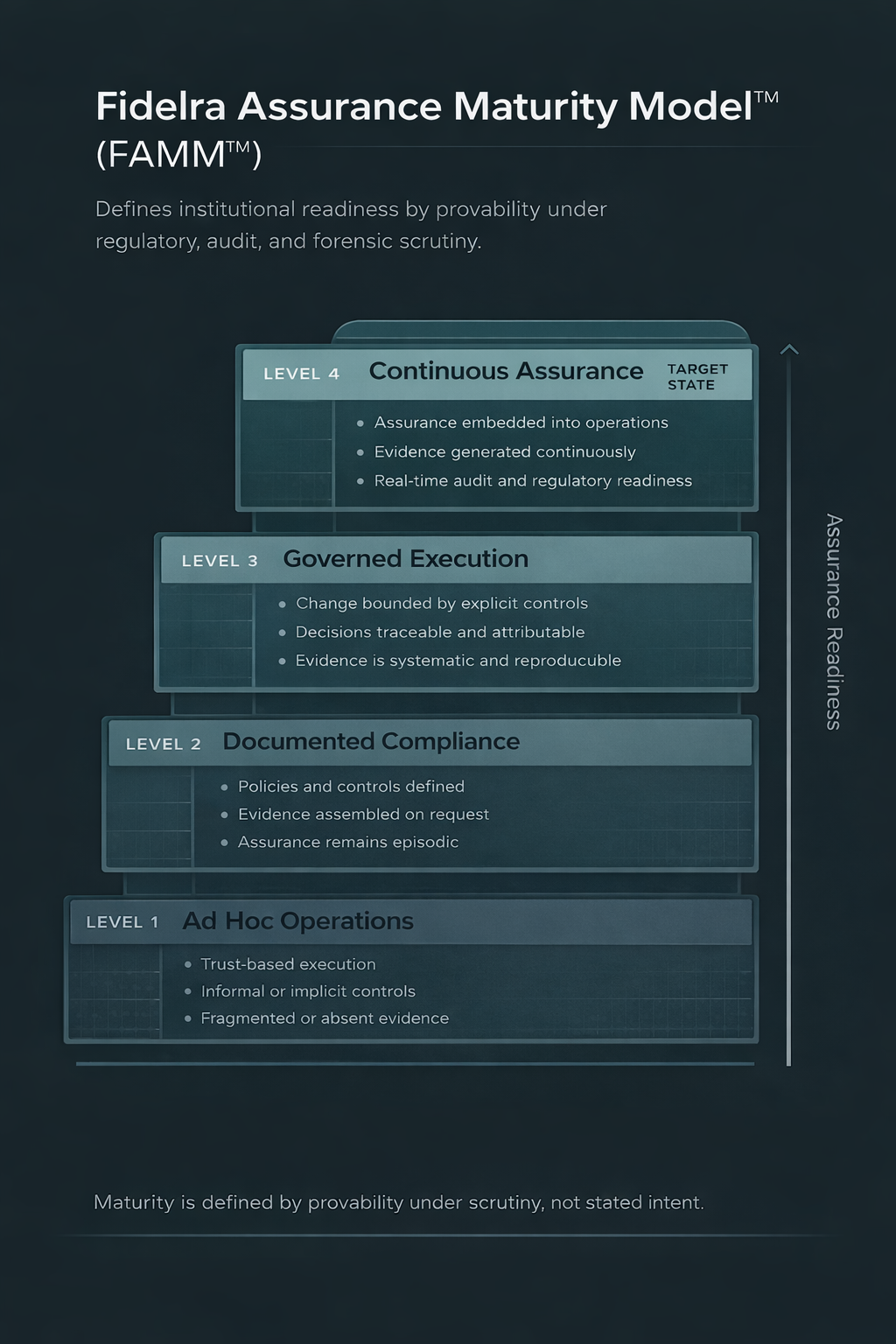
The Fidelra Assurance Maturity Model™ (FAMM™)
FAMM™ defines institutional readiness by provability, not aspiration.
It measures how defensible a data environment is under real scrutiny.
The Reality Check
- Most African institutions operate at Level 1–2
- Regulators increasingly expect Level 3+
-
This mismatch—not technology—is the continent’s core data risk.
The Regulatory Shift:
From Intention to Proof
Africa’s regulatory landscape has moved decisively beyond the grace period.
From Kenya’s Office of the Data Protection Commissioner (ODPC), to Nigeria’s Data Protection Commission (NDPC), to South Africa’s Information Regulator, expectations are converging around a single principle:
Regulators no longer ask what you intend to do.
They ask what you can prove.
This shift reflects a global regulatory reality: compliance is no longer a narrative exercise. Policies, frameworks, and declarations are insufficient unless they are supported by continuous, verifiable evidence.
Yet most institutions still rely on episodic assurance:
- Evidence assembled only when requested
- Controls described, not continuously validated
- Decisions justified after the fact
In the modern digital economy, compliance without continuous evidence is a story—not a control.
The FAF™ Lens: Assurance as Architecture
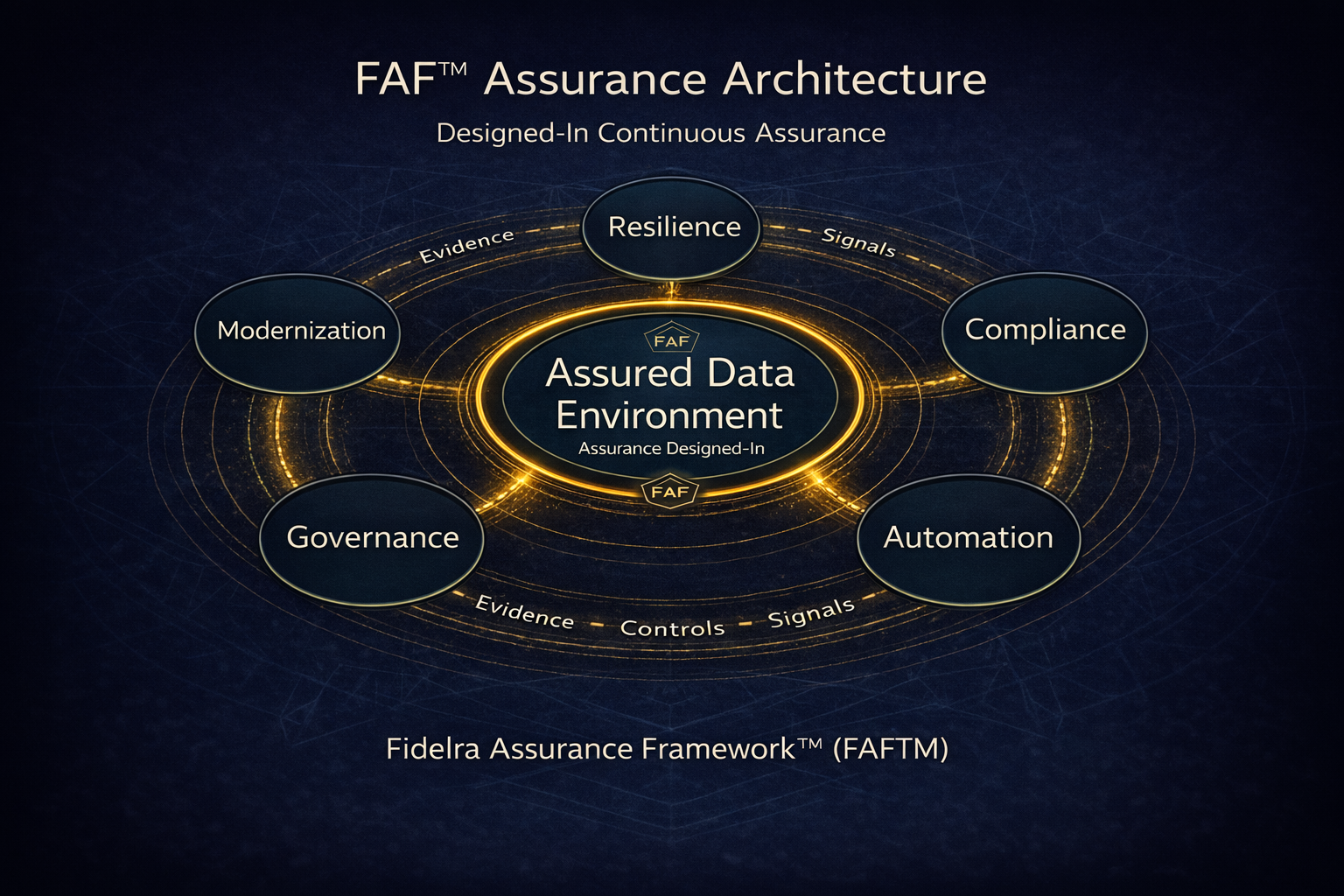
The Fidelra Assurance Framework (FAF™) is an institutional architecture designed to move organizations up the assurance maturity curve—from discretionary execution to governed, provable operation.
FAF™ is not a checklist.
It is assurance architecture.
Rather than treating assurance as an after-the-fact activity, FAF™ embeds control, evidence, and accountability into how data environments are designed and operated.
It functions across five interdependent domains:
- Modernization — Change is sequenced, bounded, and defensible
- Resilience — Availability and recovery are measured, not assumed
- Compliance — Regulatory alignment is embedded, not retrofitted
- Governance — Accountability and control are made explicit
- Automation — Assurance scales with the platform
Together, these domains transform assurance from an episodic activity into a continuous, institution-wide state.
Quantifying Fragility Through Maturity
The impact of assurance maturity becomes clear during audits and investigations:
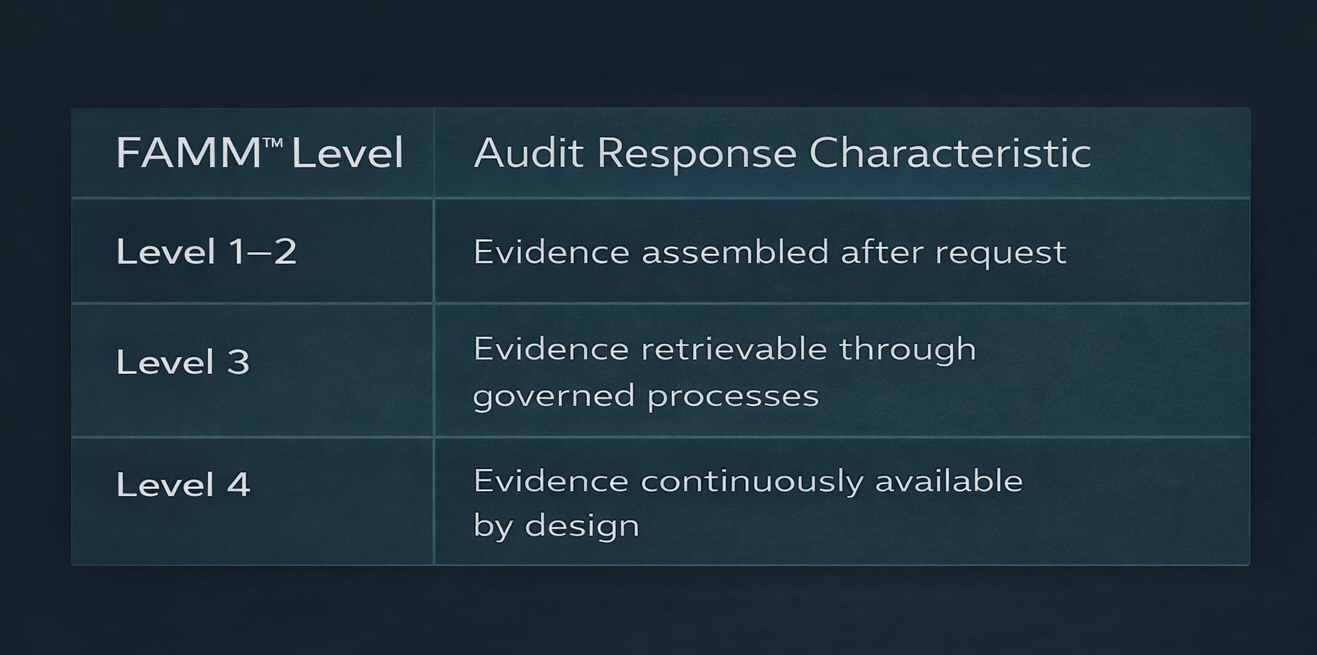
Assurance maturity determines whether scrutiny becomes:
- A controlled validation
- Or an institutional disruption
The Hidden Constraint: Assurance Is a Capability, Not a Role
Closing the Assurance Gap is not solely a technology challenge.
It is a
capability challenge.
Most organizations are structured around compliance functions designed for episodic reporting—policy interpretation, checklist validation, and regulatory correspondence.
These roles are necessary. They are institutionally insufficient.
Assurance requires a different professional orientation: one focused on control design, evidence flow, and continuous verification.
Compliance vs Assurance Orientation
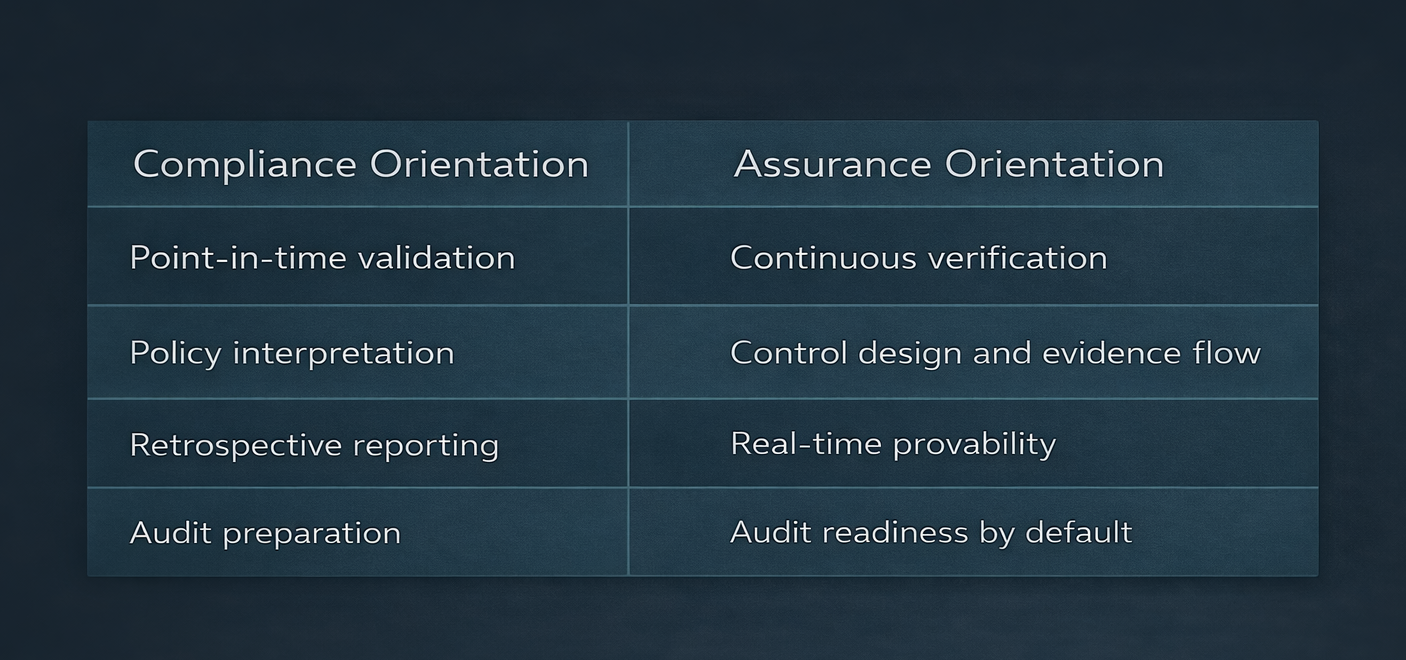
Without this capability shift, digital transformation scales complexity faster than control.
The Structural Conclusion
Africa’s data future will not be determined by how fast platforms scale.
It will be determined by how defensible those platforms are under scrutiny.
Digital growth without assurance is not progress.
It is deferred risk.
The institutions that lead Africa’s next data chapter will not be those that modernize fastest—but those that embed assurance by design.
About Africa Insights
Africa Insights is Fidelra’s institutional research and thought-leadership platform examining data assurance maturity, regulatory evolution, and modernization risk across the African continent.