The Fidelra Improvement Cycle
A governed cycle that converts assessment into sustained assurance and modernization.
Built on FAF™ · Executed through FME™
Why the Improvement Cycle Exists
Improvement fails when it is treated as a one-time project.
Data environments evolve continuously — platforms change, regulations shift, and risk re-emerges. Without a governed cycle, clarity degrades and control is lost.
The Fidelra Improvement Cycle ensures improvement is measurable, defensible, and sustained.
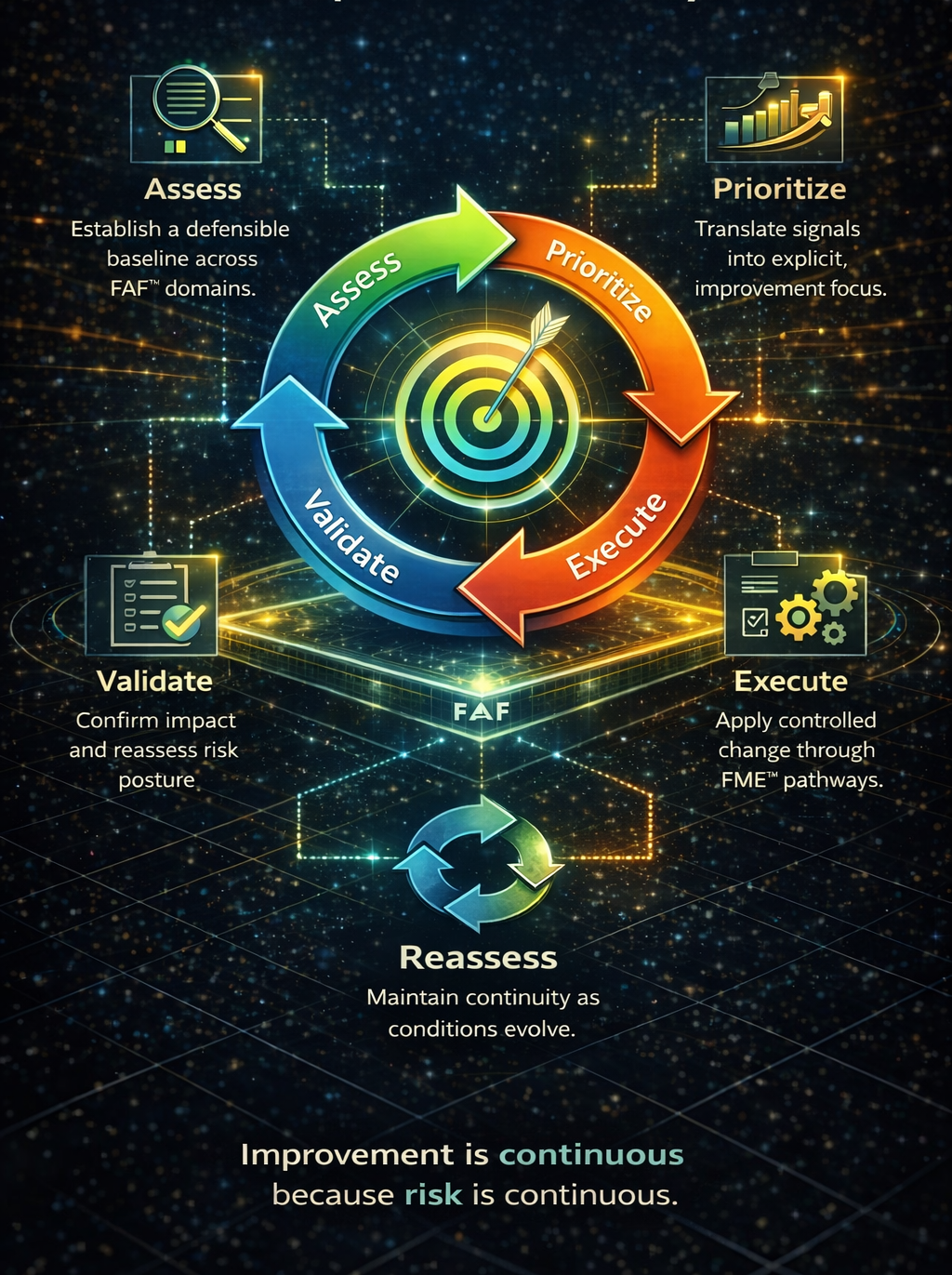
The Improvement Cycle
Assess
Establish a defensible baseline across FAF™ domains.
Prioritize
Translate signals into explicit, weighted improvement focus.
Execute
Apply controlled change through FME™ pathways.
Validate
Confirm impact and reassess risk posture.
Reassess
Maintain continuity as conditions evolve.
A Governed System for Sustained Improvement
The Fidelra Improvement Cycle aligns governance, execution, and accountability into a single, repeatable system.
What Makes This Different
- Governed, not ad-hoc
- Evidence-based, not opinion-driven
- Measurable, not subjective
- Repeatable, not consultant-dependent
FAF™ and FME™ in the Cycle
FAF™
defines what must improve and why.
FME™ defines how improvement is executed safely.
The Improvement Cycle ensures both operate as one system.
Who This Is For
- Regulated or high-risk environments
- Complex, evolving data platforms
- Leadership teams requiring sustained accountability
-
- One-time projects
- Cosmetic transformations
- Speed without control
Entering the Improvement Cycle
Organizations typically enter through:
- A Readiness Assessment
- A compliance or audit trigger
- A modernization or stabilization initiative
Once entered, improvement becomes continuous — not reactive.
Senior-led · Governed · Evidence-based