
FAF™ | Evidence & Auditability
Assurance That Holds Up Under Scrutiny
Framework Foundations
FAF™ makes assurance defensible
Every score is grounded in real system signals, validated controls, and traceable logic—supported by hard evidence, not assumptions. The result is assurance that executives can trust, auditors can verify, and regulators can accept.
This is not narrative maturity.
This is provable fact.
Why Evidence Matters
Why Evidence Matters
Assurance fails without defensible evidence.
Controls often exist only on paper. Validation is sporadic. Evidence is fragmented. Audits pass — until they don’t.
FAF™ links assurance directly to system signals—making audit readiness a structural property, not a reporting exercise.
Assurance is earned—not assumed.
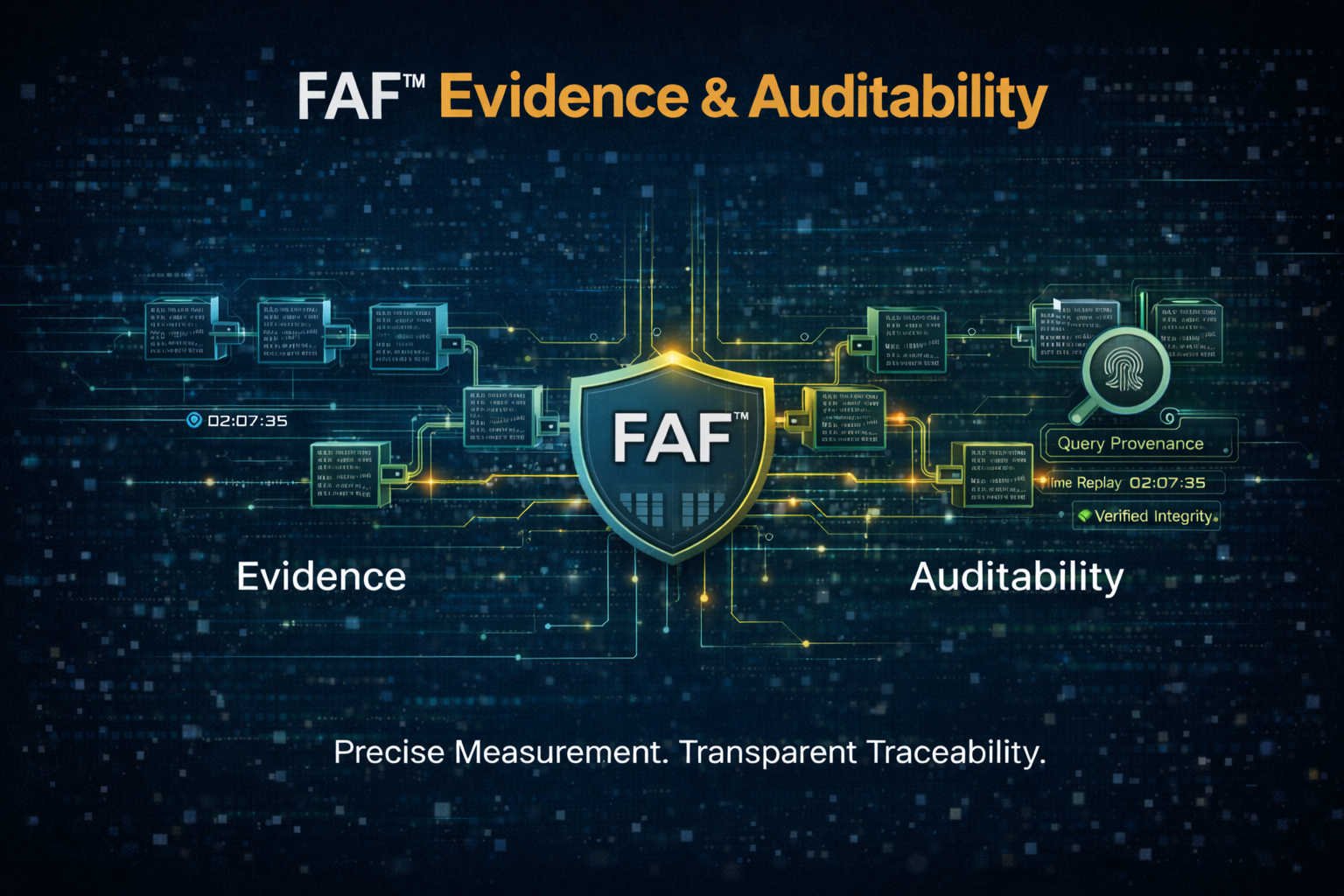
Why Evidence Matters
What Counts as Evidence in FAF™
FAF™ recognizes only evidence that meets all four criteria below.
Controls are considered valid only when outcomes can be independently reproduced using the same system logic and authoritative data sources.
Policies without verification, screenshots without execution context, and attestations without revalidation are explicitly excluded.
System-Derived
Collected directly from platforms, configurations, telemetry, or automation—not interviews or self-reports.
Verifiable
Independently reproducible by auditors using the same logic and sources.
Time-Bound
Timestamped with collection time, freshness windows, and defined validation frequency.
Traceable
Explicitly linked to a control, domain, rule, and score impact.
IF IT CANNOT BE REVALIDATED, IT DOES NOT COUNT
How FAF™ Builds
Audit-Ready Assurance
FAF™ links controls directly to system signals and evidence—making assurance audit-ready by design.
Validation is continuous: evidence refreshed, drift detected, scores updated.
Assurance is earned—not assumed.
Evidence
Is the Assurance
FAF™ does not score opinions, reward intent, or assume compliance.
Only evidence that can be validated, reproduced, and re-verified affects the score.