AI Governance: From Policy to Provable Control
Operationalizing defensible AI in regulated environments
Published: January 2026
The End of Symbolic Compliance: Why AI Governance Needs a Forensic Reset
Executive Summary
The rapid enforcement of frameworks like the
EU AI Act, DORA, and NIS2
marks a decisive shift in global governance. In the age of agentic automation, policies and ethics statements are no longer sufficient. Institutions must now prove — with evidence — that automated systems execute decisions under authorized human control
Compliance has moved from aspiration to ex-post evidentiary accountability.
The Core Failure in Today’s AI Governance
Most AI governance efforts still focus on:
- Normative ethics (fairness, transparency), or
- Audit as a procedural checkbox
What they miss is the operational layer: the actual data estates, identity controls, and execution paths where decisions occur.
This creates a Responsibility Gap — institutions cannot reliably attribute automated outcomes back to human-delegated authority. Failures happen not because rules are absent, but because authorized execution cannot be proven.
From Compliance to Defensibility
What’s required now is a new operating principle: the Logic of Defensibility.
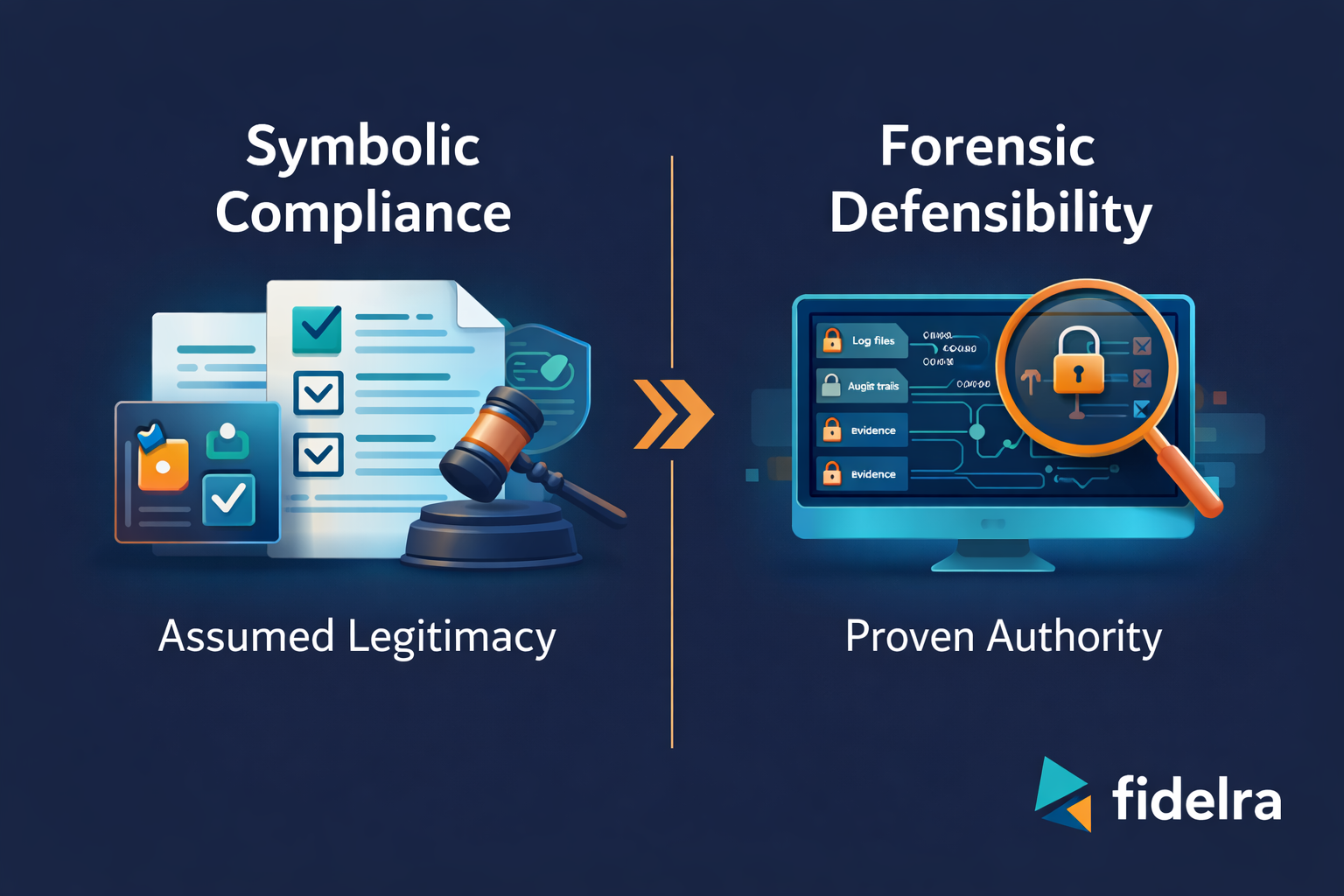
Institutional legitimacy is no longer assumed. It is forensically established — only proven through the ability to withstand structured scrutiny by regulators, auditors, or courts.
This means a shift toward:
- Execution + Evidence as the primary pillars of trust
- Governance designed for post-incident examination, not pre-incident promises
The Institutional Assurance Model (IAM) reframes governance as an evidence discipline — grounded in executional proof, not symbolic compliance.
What This Means for Leaders
This is not about algorithms. It is about institutional survival.
If you are a CRO, General Counsel, CISO, or AI Governance leader, your priority must shift toward building defensive governance architectures — systems that can produce, preserve, and defend evidence under regulatory pressure.
Why This Matters for Africa
Africa does not suffer from a lack of laws or principles. It suffers from the absence of operational accountability infrastructure.
At Fidelra Africa, this is the gap we are addressing:
- Turning policy into provable execution
- Turning compliance into measurable assurance
- Moving institutions from dependency to defensibility
The era of symbolic compliance is ending.
Trust now belongs to institutions that can prove their authority.