The Evidence Era of AI Governance
Where AI Governance Becomes Evidence
Published: March, 2026
Africa Insight (Part 1/3)
The Quiet Window Before the AI Compliance Wall
Most organizations assume that the era of AI regulation will arrive as a visible disruption — a moment marked by new laws, enforcement notices, or sudden restrictions. The expectation is that there will be a clear signal, something unmistakable that tells the market: this is when everything changes.
That assumption is flawed.
Regulatory shifts of this magnitude rarely announce themselves dramatically. They emerge quietly, forming beneath the surface while adoption accelerates above it. By the time enforcement becomes visible, the expectations, mechanisms, and control structures are already in place.
We are currently in that early phase — a period best described as The Quiet Window.
Understanding the Quiet Window
The Quiet Window is not a gap in regulation. It is a phase of construction.
On one side, organizations are rapidly embedding AI into their operations — automating decisions, optimizing processes, and reshaping customer experiences. The pace is driven by competitive pressure and the promise of efficiency.
On the other side, regulators are defining how this new layer of decision-making will be governed. They are establishing what accountability looks like in an AI-driven environment — how decisions must be explained, how data must be traced, and how responsibility must be assigned.
Because enforcement is not yet visible, many leaders interpret this moment as low risk.
In reality, it is the opposite.
This is the only phase where preparation is possible without penalty.
A Timeline Already in Motion
The transition into AI governance is not hypothetical. It is already structured, and its phases are becoming increasingly clear.
2026 — The Transparency Era
The first expectation is clarity.
Organizations will be required to explain how their AI systems make decisions — not at a conceptual level, but in a way that reflects actual system behavior. This includes understanding model logic, data inputs, and decision pathways.
If an organization cannot answer the question, “How did this system produce this outcome?”, it begins to lose credibility. Trust erodes — not just with regulators, but with customers and investors.
Transparency is the threshold. It determines whether an organization understands its own systems.
2027 — The Proof Era
Once explanation becomes standard, the next requirement emerges: proof.
Organizations must demonstrate that their explanations are accurate, reproducible, and supported by technical evidence. This introduces new expectations around data lineage, audit trails, and system observability.
If this evidence cannot be produced, the system is no longer treated as trustworthy. It is classified as high-risk by default.
At that point, consequences become operational. Procurement slows. Risk escalates. Deployment decisions are delayed or blocked — not because the system failed technically, but because it cannot be defended.
2028 — The Enforcement Era
By the time enforcement begins, the expectations are already defined.
What changes is the consequence.
Organizations that cannot produce evidence will encounter direct barriers:
- Restrictions on system usage
- Limitations on market access
- Regulatory intervention
- Potential suspension of AI capabilities
The compliance conversation fundamentally shifts.
It moves from:
"What is your AI governance policy?"
to
"Show us the evidence behind this decision."
The Quiet Window Timeline
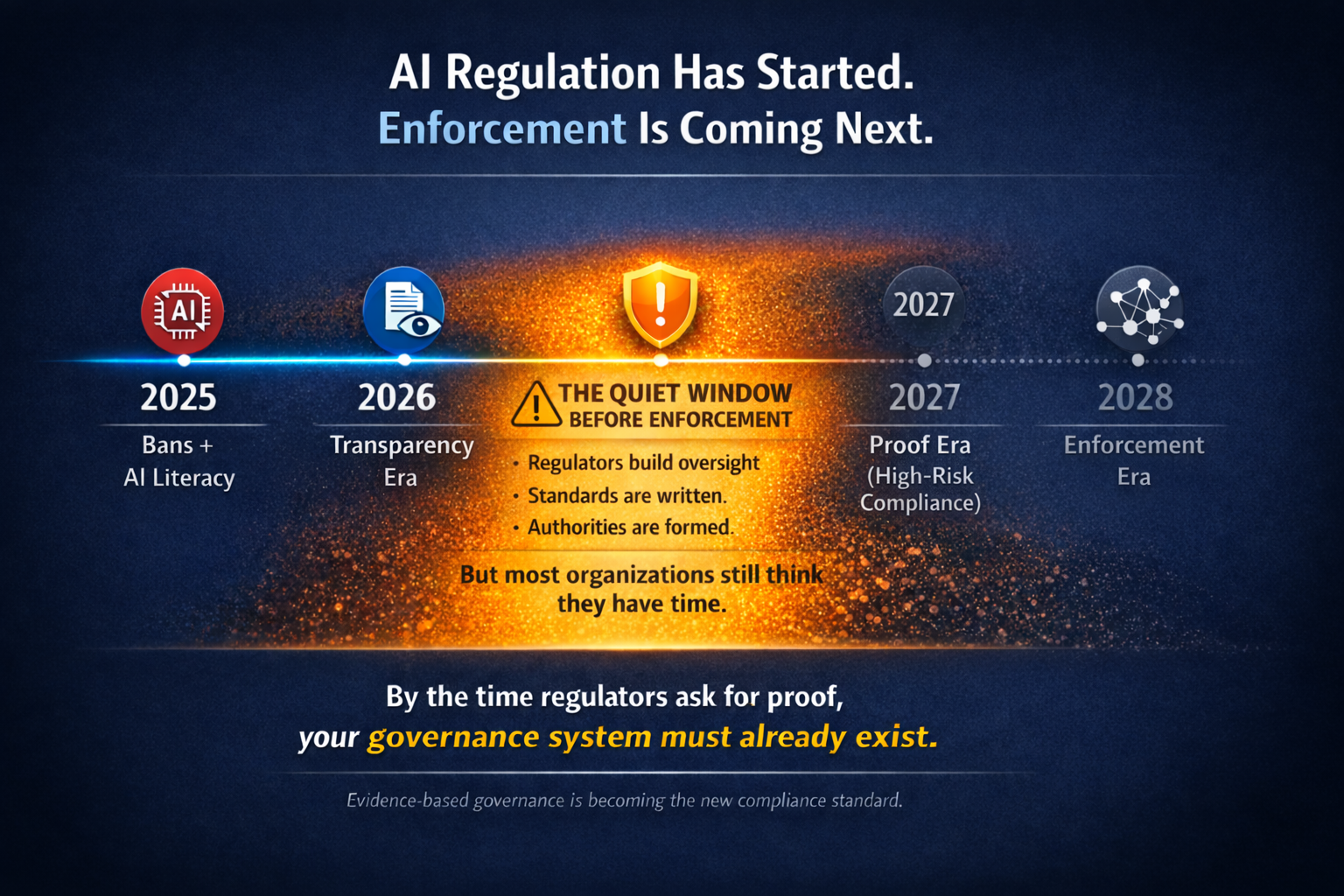
The timeline is not theoretical — it is already unfolding.
We are currently operating inside the Quiet Window: a brief period where AI adoption is accelerating, while regulatory enforcement mechanisms are still being finalized.
Most organizations interpret this phase as low risk.
In reality, it is the last opportunity to build the evidence capabilities that future compliance will require.
By the time enforcement becomes visible, the standard will already be set.
The Deeper Shift: From Documentation to Demonstration
For decades, compliance has been document-driven.
Organizations produced policies, frameworks, and audit reports to demonstrate intent. This model worked because systems were relatively deterministic and human-auditable.
AI changes that.
AI systems are dynamic, data-driven, and often non-intuitive in how they produce outcomes. In this environment, documentation alone cannot validate behavior.
A policy does not prove that a system acted correctly in a specific instance.
As a result, compliance is shifting.
It is moving from what is written to what can be demonstrated.
The Emergence of Evidence as a Capability
Evidence, in this new context, is not a static artifact.
It is a system capability.
An organization operating in the evidence era can:
- Reconstruct any AI decision with precision
- Trace data from origin to outcome
- Demonstrate how a model behaved under specific conditions
- Produce audit-ready outputs on demand
This requires systems to be designed for accountability from the start.
It cannot be retrofitted easily.
The Strategic Question
At this stage, readiness is best measured with a single operational question:
If a regulator asks how an AI decision was made ten minutes ago,
can your organization produce the evidence in ten seconds?
If the answer is no, the organization does not yet have an evidence system.
It has an AI system without a defensible audit layer.
Why This Moment Matters
The Quiet Window is short.
It is the only period where organizations can build evidence capabilities without immediate regulatory pressure.
Those who act now will define trust in their markets.
Those who delay will be forced to retrofit accountability into systems that were never designed for it — a far more difficult and costly path.
🔜 Part 2 — The Evidence Stack
In the next part, we move from concept to construction:
- What an evidence-ready AI architecture looks like
- The difference between logging and true auditability
- Why most current AI systems fail reconstruction requirements
Closing Perspective
In the next part, we move from concept to construction:
- What an evidence-ready AI architecture looks like
- The difference between logging and true auditability
- Why most current AI systems fail reconstruction requirements
Trust will no longer be declared. It will be engineered.
And the organizations that understand this during the Quiet Window will be the ones that continue operating freely when the Compliance Wall becomes real.